 Add to Chrome
 Add to Firefox
 Add to Edge
Beyond Extrapolation: Knowledge Utilization Paradigm with Bidirectional Inspiration for Time Series Forecasting
May 19, 2026
Time-series forecasting is critical in various scenarios, such as energy, transportation, and public health. However, most existing forecasters rely primarily on one-way inference, \textit{i.e.}, mapping \textbf{history} to \textbf{target}, and overlook the structural information provided by a revised natural chain (``\textbf{history} (model input) -- \textbf{target} (ground-truth output) -- \textbf{post-target continuation}''). The post-target continuation records how trajectories evolve after the target, which can help stabilize forecasting, but it is not observable at inference time. In this work, we aim to obtain an approximate proxy of the post-target continuation for the current input, providing structural knowledge for bidirectional forecasting. This idea is instantiated as KUP-BI (Knowledge Utilization Paradigm with Bidirectional Inspiration), a new time-series modeling paradigm that distills continuation-style knowledge (as an approximate post-target continuation proxy) from a \emph{train-only} historical library and integrates it into standard forecasting backbones. The input stream and the continuation-proxy stream are fused via a lightweight feature-level gating module. This design does not introduce information beyond what is already contained in the training trajectories; instead, it provides a structured inductive bias that helps backbones exploit typical continuation patterns rather than relying solely on parametric extrapolation. Experimental results on six public datasets show that KUP-BI consistently improves the forecasting performance of state-of-the-art models, with small additional overhead.

Phy-CoSF: Physics-Guided Continuous Spectral Fields Reconstruction and Super-Resolution for Snapshot Compressive Imaging
May 13, 2026Recent advances have demonstrated that coded aperture snapshot spectral imaging (CASSI) systems show great potential for capturing 3D hyperspectral images (HSIs) from a single 2D measurement. Despite the inherent spectral continuity of scenes captured by CASSI, most existing reconstruction methods are restricted to fixed, discrete spectral outputs, thereby precluding continuous spectral reconstruction or spectral super-resolution. To address this challenge, we propose Phy-CoSF, which synergizes deep unfolding networks with implicit neural representations, establishing a new paradigm for continuous spectral reconstruction and super-resolution in CASSI. Specifically, we propose a two-phase architecture that bridges discrete-wavelength training with continuous spectral rendering, enabling the synthesis of high-fidelity HSIs at arbitrary target wavelengths. At the core of our framework lies the continuous spectral fields (CoSF) module, embedded within each unfolding stage as a dynamic prior, which comprises a triple-branch cross-domain feature mixer for comprehensive spatial-frequency-channel feature fusion, alongside a spectral synthesis head that generates spectral intensities by querying continuous wavelength coordinates. Extensive experimental results demonstrate that Phy-CoSF not only achieves continuous modeling at arbitrary spectral resolutions but also outperforms many state-of-the-art methods in both reconstruction fidelity and spectral detail preservation. Our code and more results are available at: https://github.com/PaiDii/Phy-CoSF.git.
Learning Feature Encoder with Synthetic Anomalies for Weakly Supervised Graph Anomaly Detection
May 12, 2026Weakly supervised graph anomaly detection aims to unveil unusual graph instances, e.g., nodes, whose behaviors significantly differ from normal ones, given only a limited number of annotated anomalies and abundant unlabeled samples. A major challenge is to learn a meaningful latent feature representation that reduces intra-class variance among normal data while remaining highly sensitive to anomalies. Although recent works have applied self-supervised feature learning for graph anomaly detection, their strategies are not specifically tailored to its unique requirements, motivating our exploration of a more domain-specific approach. In this paper, we introduce a weakly supervised graph anomaly detection method that leverages a feature learning strategy tailored for graph anomalies. Our approach is built upon a multi-task learning scheme that extracts robust feature representations through synthesized anomalies. We generate synthetic anomalies by perturbing the normal graph in various ways and assign a dedicated detection head to each anomaly type, ensuring that learned features are sensitive to potential deviations from normal patterns. Although synthetic anomalies may not perfectly replicate real-world patterns, they provide valuable auxiliary data for effective feature learnin, much like features learned from ImageNet classification transfer to downstream vision tasks. Additionally, we adopt a two-phase learning strategy: an initial warm-up phase using only synthetic samples, followed by a full-training phase integrating both tasks, to balance the influence of synthetic and real data. Extensive experiments on public datasets demonstrate the superior performance of our method over its competitors. Code is available at https://github.com/yj-zhou/SAWGAD.
* 14 pages, 7 figures, published by IEEE Transactions on Knowledge and Data Engineering,2026
Differentiable Vector Quantization for Rate-Distortion Optimization of Generative Image Compression
Apr 12, 2026The rapid growth of visual data under stringent storage and bandwidth constraints makes extremely low-bitrate image compression increasingly important. While Vector Quantization (VQ) offers strong structural fidelity, existing methods lack a principled mechanism for joint rate-distortion (RD) optimization due to the disconnect between representation learning and entropy modeling. We propose RDVQ, a unified framework that enables end-to-end RD optimization for VQ-based compression via a differentiable relaxation of the codebook distribution, allowing the entropy loss to directly shape the latent prior. We further develop an autoregressive entropy model that supports accurate entropy modeling and test-time rate control. Extensive experiments demonstrate that RDVQ achieves strong performance at extremely low bitrates with a lightweight architecture, attaining competitive or superior perceptual quality with significantly fewer parameters. Compared with RDEIC, RDVQ reduces bitrate by up to 75.71% on DISTS and 37.63% on LPIPS on DIV2K-val. Beyond empirical gains, RDVQ introduces an entropy-constrained formulation of VQ, highlighting the potential for a more unified view of image tokenization and compression. The code will be available at https://github.com/CVL-UESTC/RDVQ.
MobileIE: An Extremely Lightweight and Effective ConvNet for Real-Time Image Enhancement on Mobile Devices
Jul 02, 2025Recent advancements in deep neural networks have driven significant progress in image enhancement (IE). However, deploying deep learning models on resource-constrained platforms, such as mobile devices, remains challenging due to high computation and memory demands. To address these challenges and facilitate real-time IE on mobile, we introduce an extremely lightweight Convolutional Neural Network (CNN) framework with around 4K parameters. Our approach integrates reparameterization with an Incremental Weight Optimization strategy to ensure efficiency. Additionally, we enhance performance with a Feature Self-Transform module and a Hierarchical Dual-Path Attention mechanism, optimized with a Local Variance-Weighted loss. With this efficient framework, we are the first to achieve real-time IE inference at up to 1,100 frames per second (FPS) while delivering competitive image quality, achieving the best trade-off between speed and performance across multiple IE tasks. The code will be available at https://github.com/AVC2-UESTC/MobileIE.git.
Generative Image Compression by Estimating Gradients of the Rate-variable Feature Distribution
May 27, 2025While learned image compression (LIC) focuses on efficient data transmission, generative image compression (GIC) extends this framework by integrating generative modeling to produce photo-realistic reconstructed images. In this paper, we propose a novel diffusion-based generative modeling framework tailored for generative image compression. Unlike prior diffusion-based approaches that indirectly exploit diffusion modeling, we reinterpret the compression process itself as a forward diffusion path governed by stochastic differential equations (SDEs). A reverse neural network is trained to reconstruct images by reversing the compression process directly, without requiring Gaussian noise initialization. This approach achieves smooth rate adjustment and photo-realistic reconstructions with only a minimal number of sampling steps. Extensive experiments on benchmark datasets demonstrate that our method outperforms existing generative image compression approaches across a range of metrics, including perceptual distortion, statistical fidelity, and no-reference quality assessments.
DeepNuParc: A Novel Deep Clustering Framework for Fine-scale Parcellation of Brain Nuclei Using Diffusion MRI Tractography
Mar 10, 2025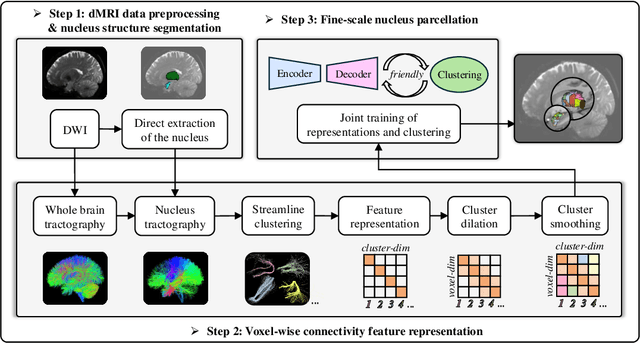
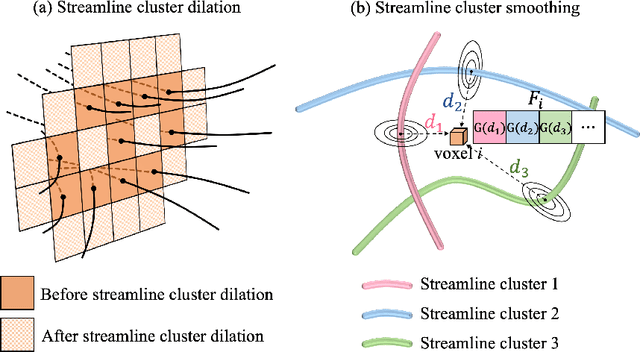
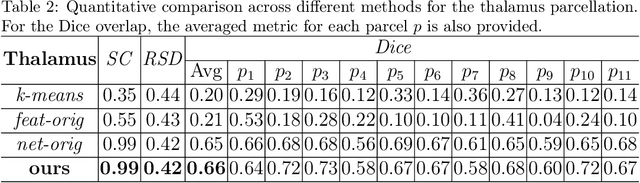
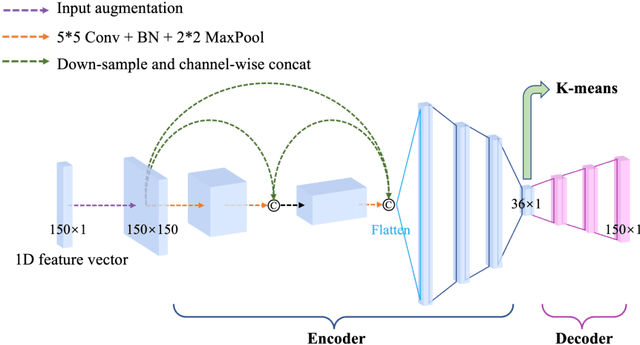
Brain nuclei are clusters of anatomically distinct neurons that serve as important hubs for processing and relaying information in various neural circuits. Fine-scale parcellation of the brain nuclei is vital for a comprehensive understanding of its anatomico-functional correlations. Diffusion MRI tractography is an advanced imaging technique that can estimate the brain's white matter structural connectivity to potentially reveal the topography of the nuclei of interest for studying its subdivisions. In this work, we present a deep clustering pipeline, namely DeepNuParc, to perform automated, fine-scale parcellation of brain nuclei using diffusion MRI tractography. First, we incorporate a newly proposed deep learning approach to enable accurate segmentation of the nuclei of interest directly on the dMRI data. Next, we design a novel streamline clustering-based structural connectivity feature for a robust representation of voxels within the nuclei. Finally, we improve the popular joint dimensionality reduction and k-means clustering approach to enable nuclei parcellation at a finer scale. We demonstrate DeepNuParc on two important brain structures, i.e. the amygdala and the thalamus, that are known to have multiple anatomically and functionally distinct nuclei subdivisions. Experimental results show that DeepNuParc enables consistent parcellation of the nuclei into multiple parcels across multiple subjects and achieves good correspondence with the widely used coarse-scale atlases. Our codes are available at https://github.com/HarlandZZC/deep_nuclei_parcellation.
Continuous Patch Stitching for Block-wise Image Compression
Feb 24, 2025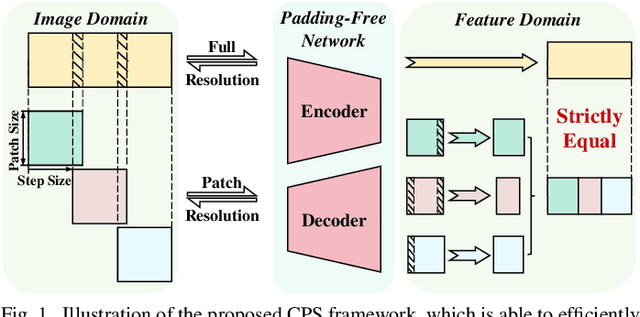
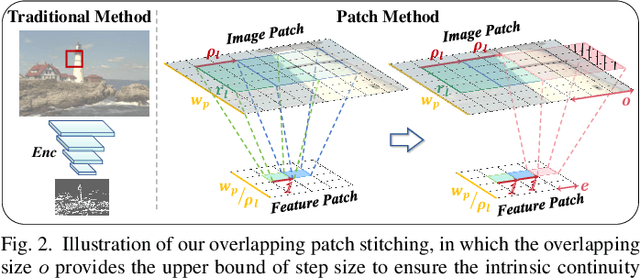
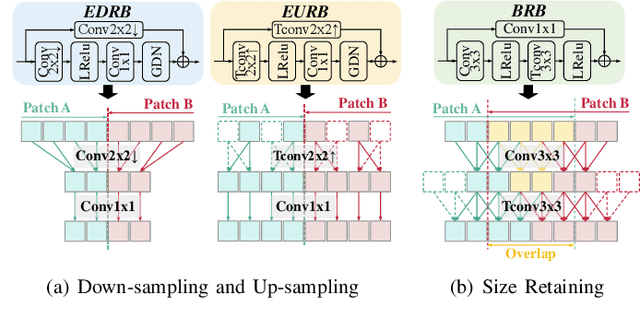
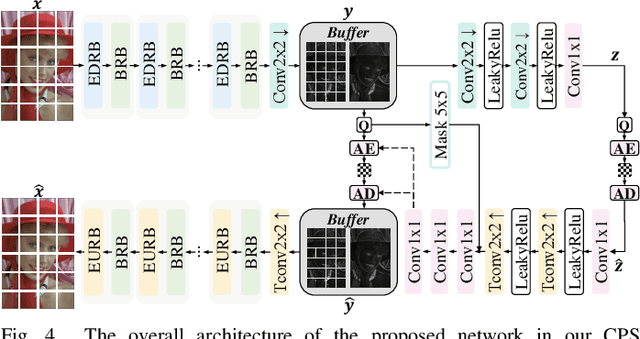
Most recently, learned image compression methods have outpaced traditional hand-crafted standard codecs. However, their inference typically requires to input the whole image at the cost of heavy computing resources, especially for high-resolution image compression; otherwise, the block artefact can exist when compressed by blocks within existing learned image compression methods. To address this issue, we propose a novel continuous patch stitching (CPS) framework for block-wise image compression that is able to achieve seamlessly patch stitching and mathematically eliminate block artefact, thus capable of significantly reducing the required computing resources when compressing images. More specifically, the proposed CPS framework is achieved by padding-free operations throughout, with a newly established parallel overlapping stitching strategy to provide a general upper bound for ensuring the continuity. Upon this, we further propose functional residual blocks with even-sized kernels to achieve down-sampling and up-sampling, together with bottleneck residual blocks retaining feature size to increase network depth. Experimental results demonstrate that our CPS framework achieves the state-of-the-art performance against existing baselines, whilst requiring less than half of computing resources of existing models. Our code shall be released upon acceptance.
Hierarchical Semantic Compression for Consistent Image Semantic Restoration
Feb 24, 2025The emerging semantic compression has been receiving increasing research efforts most recently, capable of achieving high fidelity restoration during compression, even at extremely low bitrates. However, existing semantic compression methods typically combine standard pipelines with either pre-defined or high-dimensional semantics, thus suffering from deficiency in compression. To address this issue, we propose a novel hierarchical semantic compression (HSC) framework that purely operates within intrinsic semantic spaces from generative models, which is able to achieve efficient compression for consistent semantic restoration. More specifically, we first analyse the entropy models for the semantic compression, which motivates us to employ a hierarchical architecture based on a newly developed general inversion encoder. Then, we propose the feature compression network (FCN) and semantic compression network (SCN), such that the middle-level semantic feature and core semantics are hierarchically compressed to restore both accuracy and consistency of image semantics, via an entropy model progressively shared by channel-wise context. Experimental results demonstrate that the proposed HSC framework achieves the state-of-the-art performance on subjective quality and consistency for human vision, together with superior performances on machine vision tasks given compressed bitstreams. This essentially coincides with human visual system in understanding images, thus providing a new framework for future image/video compression paradigms. Our code shall be released upon acceptance.
Triply Laplacian Scale Mixture Modeling for Seismic Data Noise Suppression
Feb 20, 2025Sparsity-based tensor recovery methods have shown great potential in suppressing seismic data noise. These methods exploit tensor sparsity measures capturing the low-dimensional structures inherent in seismic data tensors to remove noise by applying sparsity constraints through soft-thresholding or hard-thresholding operators. However, in these methods, considering that real seismic data are non-stationary and affected by noise, the variances of tensor coefficients are unknown and may be difficult to accurately estimate from the degraded seismic data, leading to undesirable noise suppression performance. In this paper, we propose a novel triply Laplacian scale mixture (TLSM) approach for seismic data noise suppression, which significantly improves the estimation accuracy of both the sparse tensor coefficients and hidden scalar parameters. To make the optimization problem manageable, an alternating direction method of multipliers (ADMM) algorithm is employed to solve the proposed TLSM-based seismic data noise suppression problem. Extensive experimental results on synthetic and field seismic data demonstrate that the proposed TLSM algorithm outperforms many state-of-the-art seismic data noise suppression methods in both quantitative and qualitative evaluations while providing exceptional computational efficiency.